

Minimalist Wasteland
On the erasure of culture via minimalist design trends

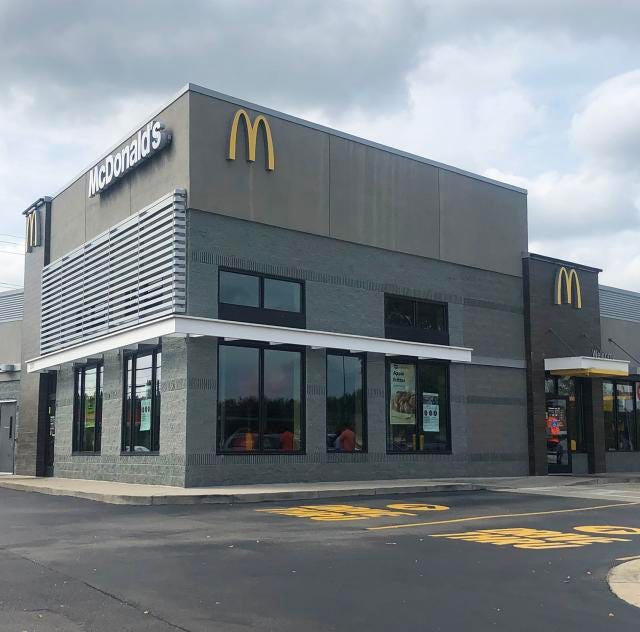
Why do today’s fast food restaurants look like prisons?
The dominant design trend today is one of minimalism. This is seen in nearly every facet of our lives and culture, from the exterior and interior design of fast food restaurants to the aesthetics and layouts of webpages, the branding and graphics of nearly every company, and even the design of our own homes. This essay on the minimalist wasteland we find ourselves in will make the case that minimalism engages in the erasure of culture and the sterilization of everyday life—to our great detriment. This can be found in the world of fast food—primarily, the interior and exterior design and branding of fast food restaurant buildings.
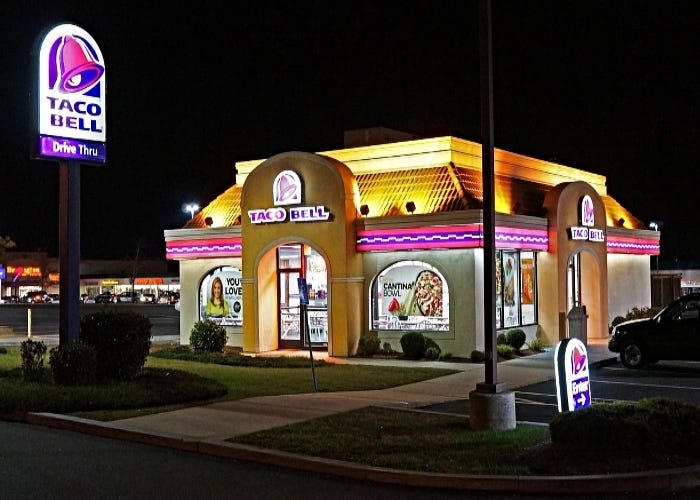
If you’re like me, the Taco Bell restaurant of your childhood boasted an immediately recognizable exterior structural design: abstract shapes, bright and contrasting colors (both warm and cool), the iconic bell logo, a textured roof, and often a rounded entry archway facade.
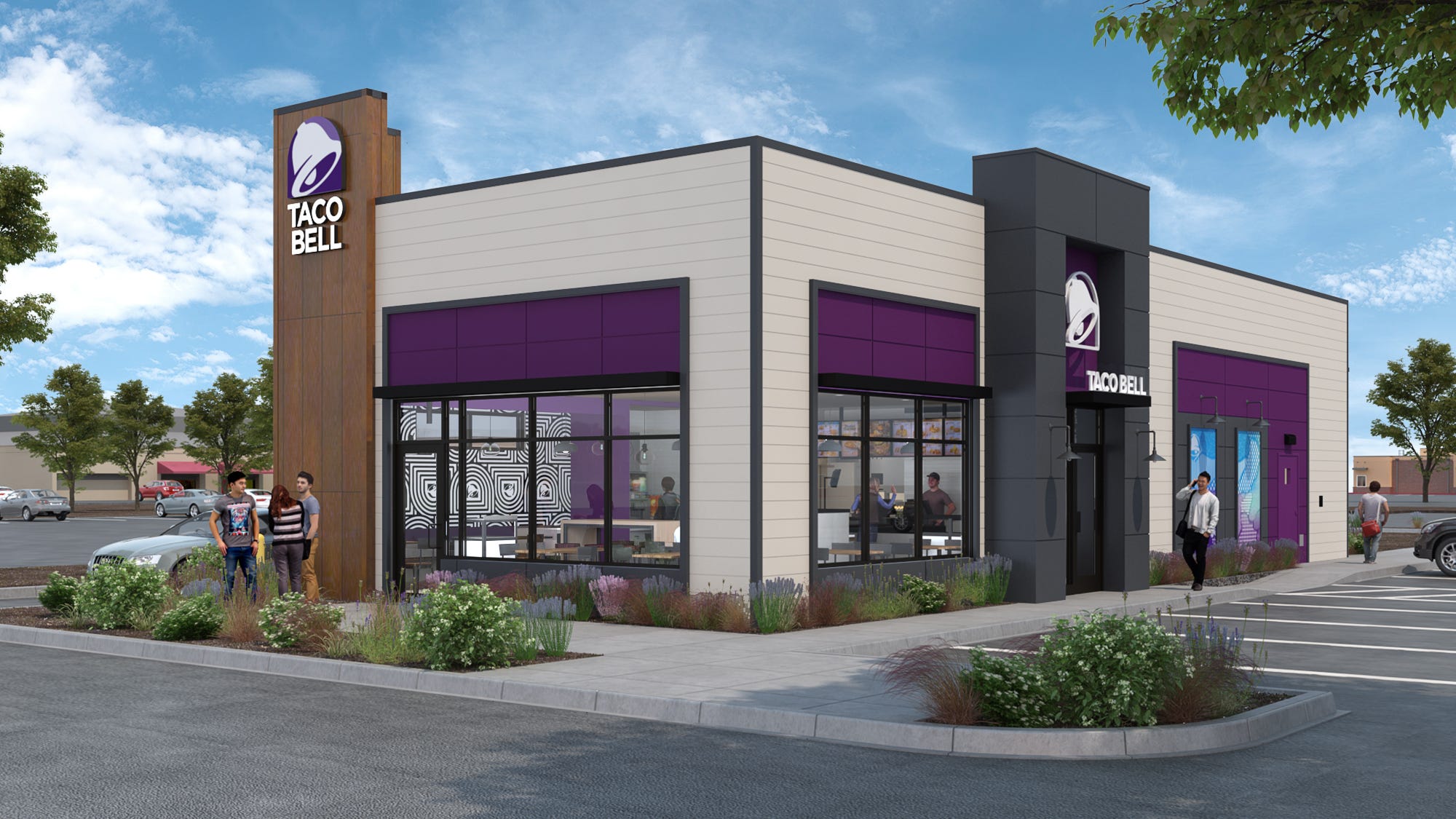
Contrast this with the current design of the Taco Bell building. It retains some color, yes—but not as much (showing more beige, brown, and grey), and gone are the interesting textures and curves, cast aside in favor of clean, straight lines and right angles. Modern corporate building design places the square and the cube on a pedestal as if these shapes were the pinnacle of aesthetics. Again, at least there is some vibrancy to be found in the modern Taco Bell—contrast this with the stark, brutalist grey of the modern McDonald’s, whose structure looks more like a dystopian prison than a place where people go to eat.
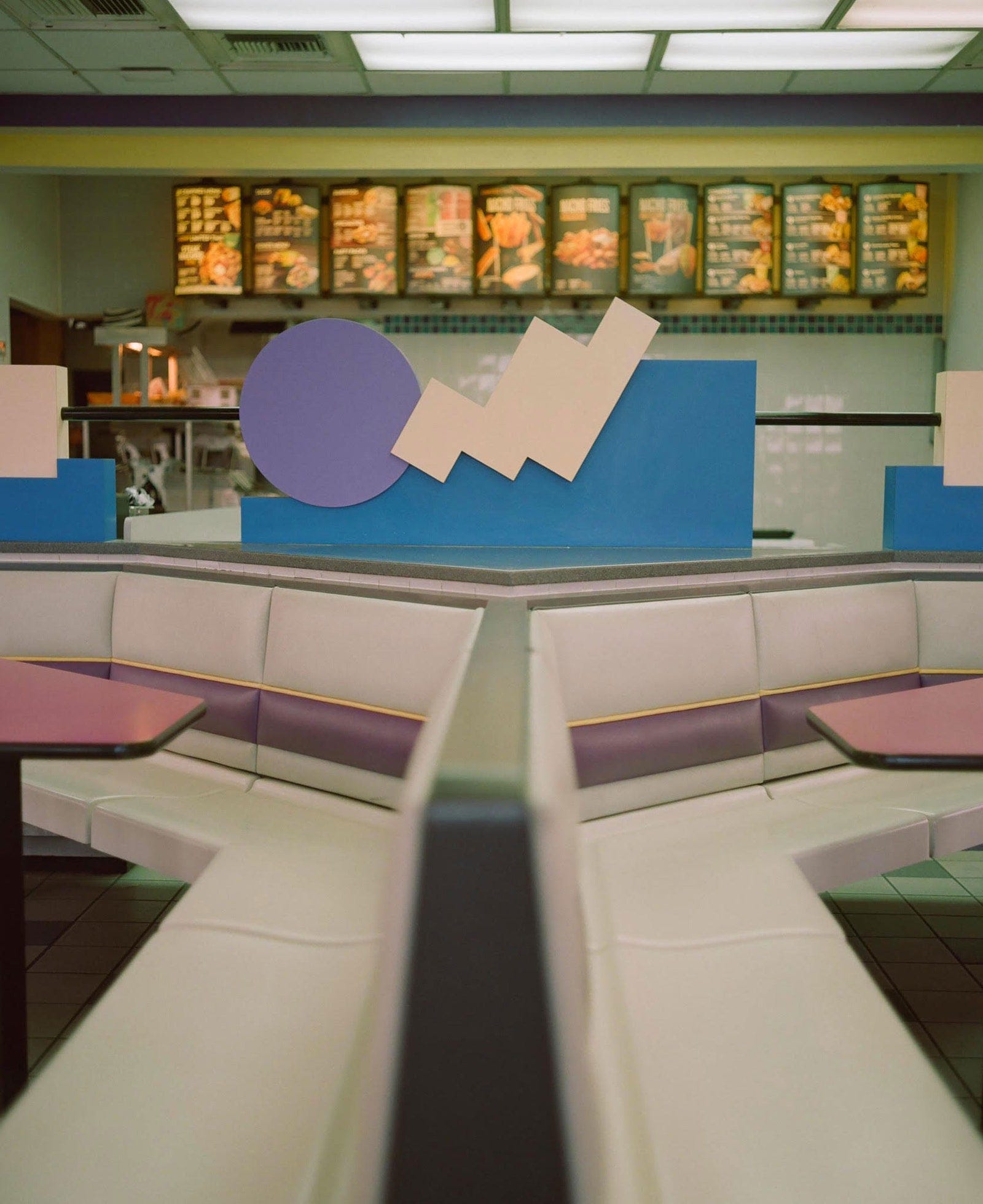
The bleakness continues inside a modern Taco Bell or McDonald’s. For 90s fast food restaurants, color and maximalist design are again central to the interior atmosphere just as for the exterior. Take the dining area of a 90s Taco Bell: classic 90s pastels and abstract shapes; warm and cool colors in contrast wherever you look. These design choices make the fast food experience fun, whether dine-in or take-out.
Of course, whether fast food should be fun is an entirely separate issue—marketing departments’ need for food to be “fun” might have something to do with the United States’ obesity epidemic, and certainly one could point to the bright colors, cartoon mascots, and so on as an attempt to market these salt and sugar-laced, calorie-loaded foods to children. Maybe it’s a good thing that fast food has “grown up” in some ways—though let’s not be so naive as to believe they no longer market to kids just because the building is grey.
The right perspective when thinking about the beigeing or beigeification of design is to acknowledge that two things can be true at the same time: first, that fast food chains have historically used design to market to vulnerable populations (i.e. children); second, that the dulling of our cultural landscape is an undesirable outcome.
It might seem dramatic to worry so much over the aesthetic design choices of corporations, but this is just one small example of how flat, dull, lifeless design has infiltrated every corner of our lives. It’s not just fast food; corporate branding in just about every industry or cultural sector has embraced flat, minimalist design. One look at the logos for NBA teams in the 90s compared to their current logos, and it’s immediately apparent that all sense of character and boldness has vanished, along with the fun.


Perhaps nowhere is this minimalist trend more prevalent than in modern web design. If you’ve ever noticed that every webpage these days looks the same, you can blame flat design: a design philosophy centered around simplicity and minimalism. Long gone are the days of Geocities and vibrant colors and dancing GIFs. Sure, websites these days are more accessible (and accessibility is important!), and we have less clashing colors—no more do I need to try to read the white text on a bright yellow background on someone’s personal webpage. But to be honest, I kind of miss that. Those early internet sites had character—something I don’t think websites these days can claim.
These days, it seems that everything—from the brands we consume, the hobbies we engage in, and the web we use to explore all of these things—is soulless and corporate. Many of these things are corporate—maybe it’s a good thing that they aren’t hiding this under a veneer of color and mascot characters. But I wonder what the psychological effect of this design flattening might be in both physical and digital spaces. Who benefits from this flattening, and what is lost when the texture of life disappears and one thing looks and feels the same as another?
What we’re witnessing isn’t simply a change in taste or branding but an alteration in the atmosphere of our world. Fun has been stripped away—more importantly, uniqueness is lost in a sea of grey and beige. Minimalism offers benefits for corporations: the fact that a McDonalds’ in upstate New York will look the same as one in Texas and the same as one in another part of the world builds a strong and instantly recognizable brand. Corporations are able to develop consistency and universality in this way—a product or brand can easily be transplanted into a new market without giving much thought (and expense) to design.
But universality, in this case, has proven to be the enemy of originality. What’s lost is a sense of place—the fact that two buildings can be nearly identical despite vast geographic distances results in a surreal, almost liminal existence.
When everything becomes clean, smooth, and simple, life becomes frictionless. But that very friction that we’re missing—the fact that an older website might be loud and obnoxious, or that two different franchises of the same restaurant might surprise us with a different design—these things are what gave texture to day-to-day life. Without maximalism, the drudgery of day-in, day-out existence is foregrounded because we see constant reminders of that same dullness.
Minimalism has its place, and I can’t deny that it’s functional. It may even be optimized. But the utter dominance of minimalism in the current moment has optimized the color out of daily life, resulting in experiences that may be orderly and neutral but are ultimately forgettable.